Search

Magnus Pharao Hansen

anthropologist – linguist

Category

Uncategorized

The Language of Teotihuacan Writing

Drawing by Christophe Helmke from the paper.

My article with Christophe Helmke, “The Language of Teotihuacan Writing”, is out in Current Anthropology 66(5):705–739.

The question of what language, if any, was recorded by the signs painted on the murals and ceramics of Teotihuacan has been contested for decades. We argue that these signs do constitute writing; that the system shares basic principles with other Mesoamerican scribal traditions, including the reading of logograms on the rebus principle; and that it employs a further principle we call double spelling. We argue that the script encoded a specific and identifiable language — a Uto-Aztecan language immediately ancestral to Nahuatl, Cora and Huichol — and we offer new readings of several Teotihuacan glyphs.

Rather than reading the signs through 16th Nahuatl, we reconstructed a form of the language that would have been contemporary with the script itself and worked from there. Reading the glyphs through modern Nahuatl would be something like reading the Jelling runestones with modern Danish: related, but not the same language.

If the argument holds, it has several major implications for how we understand Mesoamerica. The conventional account has speakers of Nahuan languages arriving in central Mexico after the fall of Teotihuacan. A Uto-Aztecan language at Teotihuacan itself would instead suggest continuity, and make later Nahua populations the descendants of the city’s inhabitants rather than newcomers to an abandoned landscape.

The article was covered widely in the international press, including in The New York Times and El País.

Nahuatl Nations published by Oxford University Press
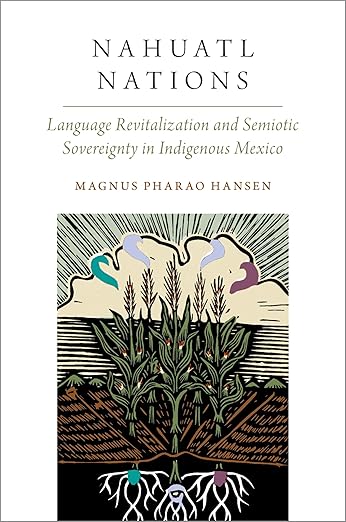
My book Nahuatl Nations: Language Revitalization and Semiotic Sovereignty in Indigenous Mexico is out with Oxford University Press, in the series Oxford Studies in the Anthropology of Language.

The book is a linguistic ethnography of the political relations between the Indigenous communities of Mexico that speak Nahuatl and the Mexican nation that claims the language as a national symbol. Drawing on long-term fieldwork in several Nahuatl-speaking communities in central Mexico, and on ethnohistorical and sociolinguistic material, it traces how those relations have been shaped over time and how they play out today in Nahua towns, in regional educational institutions, and in the Mexican diaspora in the United States.

Its central argument turns on the concept of semiotic sovereignty: a community’s capacity to govern its own semiotic resources, its language among them. I argue that Indigenous languages remain vital for as long as they are used as languages of political community, and that they protect that community by restricting outsiders’ access to participation in it. Where the Mexican state seeks to expropriate Indigenous semiotic resources to improve its brand abroad, communities can deploy those same resources in resistance to state domination.

Interview: University Post

I have been interviewed for the University Post about my new ERC-funded research project.
“He taught himself ‘Elvish’ as a child. Now he is to solve an ancient enigma in Mexico”

ERC starting grant

The Research project SUAHIST which has received a Starting Grant by the European Research Council from 2024-2029. I will be the PI, working together with a team of specialists in the Náayeri and Wixárika languages. https://ufm.dk/aktuelt/nyheder/2023/fem-danske-forskere-far-en-af-eus-fineste-forskningsbevillinger


Summary: “A thousand years before Europeans arrived in the Americas, a vast region, covering what is now North-western Mexico and the US Southwest, was inhabited by speakers of languages belonging to the Uto-Aztecan language family. Often described as nomads in a hostile periphery between the cultures of Mesoamerica and the Puebloan cultures of the US Southwest, this project instead puts the speakers of Southern (SUA) Uto-Aztecan languages at the centre, seeking to recover aspects of their language and world-view, and their historical interactions with other regions. The project brings to bear the full scope of methods of contemporary comparative historical linguistics to investigate the history of SUA peoples: It combines qualitative methods of historical linguistics and narratology with quantitative lexicostatistical and phylogeographic methods to analyse the historical relations between SUA languages, and to analyse developments of SUA mythological traditions. Integrating a component of language documentation, the project also works with indigenous scholars and communities to contribute to ongoing efforts of indigenous language maintenance.”


Feature in Babelzine

In May 2020, my research profile was featured in Babelzine, a magazine for language lovers. The article can be read here: Linguistic Horizons.

Sapere Aude – Language and Landscape

dff-logo

In December 2018 I was awarded the Sapere Aude (“Dare to know!”) Research Leader Grant of the Independent Research Fund Denmark. It is a three year grant for a project comparing spatial grammar in dialects of Nahuatl spoken in different environments and landscapes, to discover whether the different dialects have adapted their spatial grammar to features of the local landscape. I will carry out this project at the University of Copenhagen and in Mexico, in collaboration with several other scholars.

Here is a link to the profile of the research project at the website of the Independent Research Fund.

“Becoming Autonomous” out in PoLAR

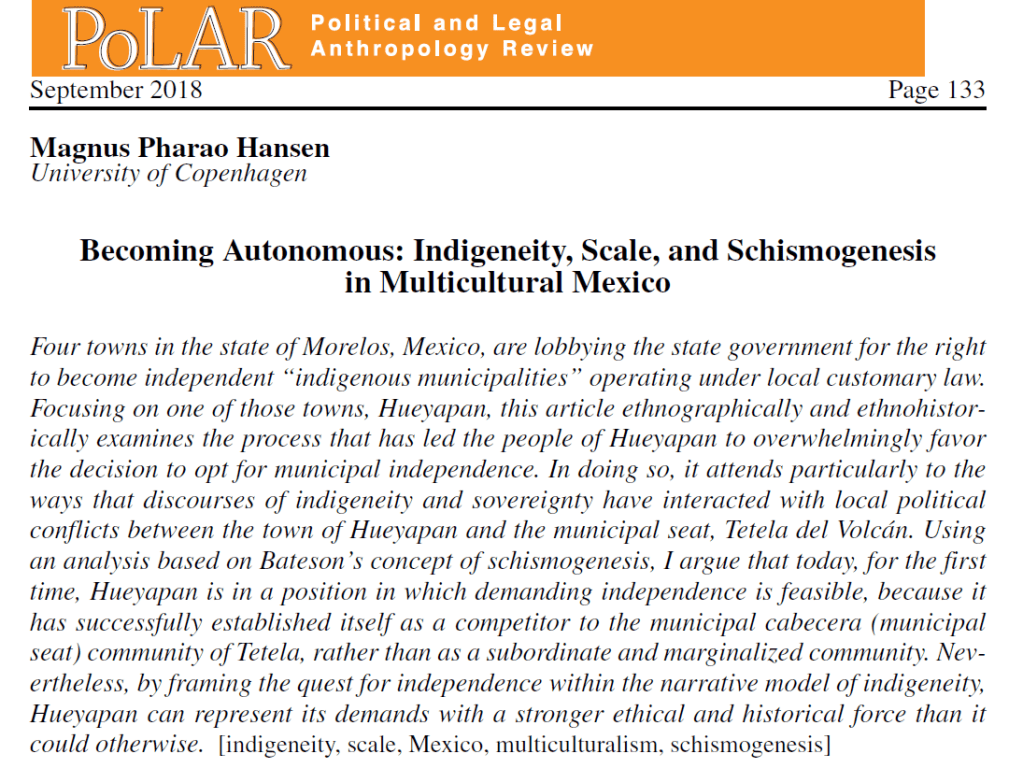
My new article “Becoming Autonomous: Indigeneity, Scale and Schismogenesis in Multicultural Mexico” is out in the September 2018 issue of Political and Legal Anthropology Review.


PoLAR abstract

Media commentary on wikipedia:

wikiwars

I’ve been used as a source for inside commentary on Wikipedia’s problems with accuracy and bias:

In March, my commentary was used in an article by The Southern Poverty Law Center on the way that some White Nationalists try to influence Wikipedia’s content to reflect their world view. This is something I have a lot of experience dealing with on Wikipedia’s pages about race, and race and intelligence.

In July, I was asked for comments about the accuracy of Wikipedia by a journalist from the Poynter Institute who was interested in how hoaxes and vandalism may stay on Wikipedia articles for years. This was made relevant by the decision of Youtube and Twitter to combat conspiracy theories and fake news by using links to wikipedia articles together with content promoting fake news or pseudoscience.


Book Out! Amapoualistle published in Mexico

Amapoualistle: Lecturas en Náhuatl de Hueyapan Morelos, a collection of texts in Nahuatl from Hueyapan, Morelos, and a short grammatical sketch and a vocabulary, was published by the State Government of Morelos in March, 2017. I collected and edited the texts, and wrote the grammar sketch and vocabulary, and compiled them for publication on the request of the Nahuatl revitalization project of Hueyapan – the Chimalnahuatlajtole Language Academy. Here are two of the members of the academy, Alex Maya and Yesenia Castellanos, at the book presentation in Mexico City on March 4th. The texts were told to me by Doña Modesta Lavana, Don Hilarin Montiel Benitez, Doña Petra Ariza Jimenez, Don Andrés Barranco Navarro and Claudia Zavala Amaro – and another couple were originally published by Miguel Barrios Espinosa in 1947. The book is not for sale but should be distributed soon, free of charge – primarily in the community.

book presentation


Blog at WordPress.com.

Up ↑