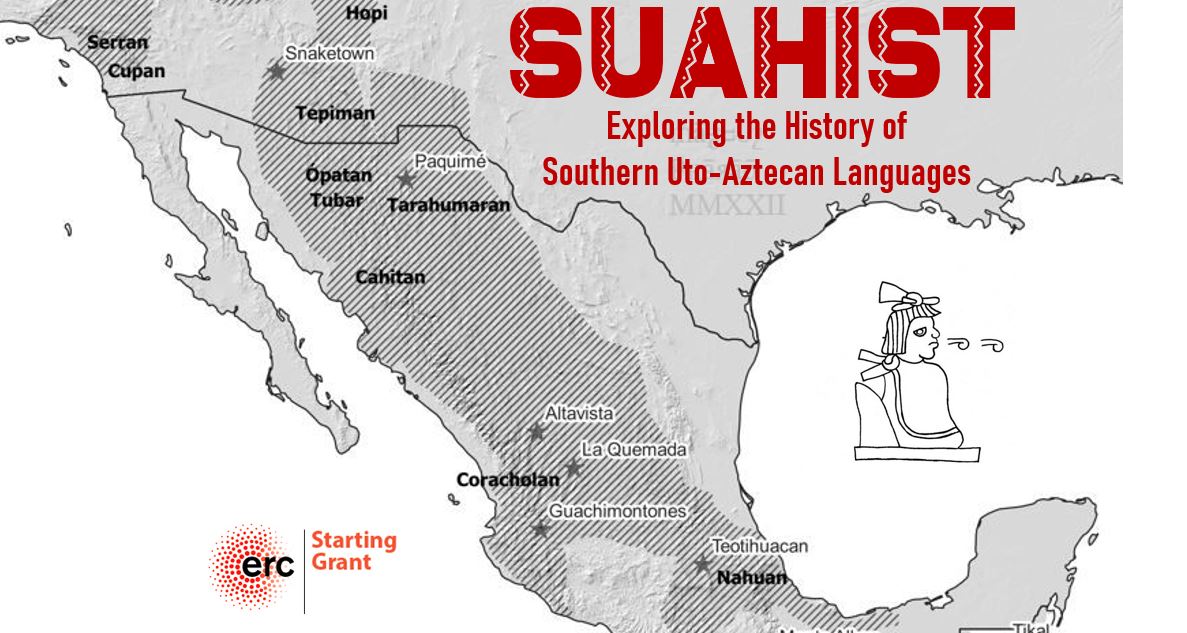
SUAHIST — Exploring the Deep History of Southern Uto-Aztecan Languages and Peoples — is a five-year project funded by a Starting Grant from the European Research Council, running from 2024 to 2029 at the Department of Cross-Cultural and Regional Studies, University of Copenhagen. I am the Principal Investigator, working with a team of specialists in the Náayeri (Cora) and Wixárika (Huichol) languages.
The problem
A thousand years before Europeans reached the Americas, a vast region covering what is now northwestern Mexico and the US Southwest was inhabited by speakers of Southern Uto-Aztecan languages. They have usually been described from the outside: as nomads occupying a hostile periphery between the urban civilizations of Mesoamerica to the south and the Puebloan cultures to the north. That framing has shaped what questions get asked about them, and what does not get asked.
SUAHIST puts the speakers of these languages at the centre instead. The aim is to recover what can be recovered of their languages, their view of the world, and their historical interactions with the regions on either side of them.
Approach
The project brings the full range of contemporary comparative-historical method to bear on this question. It combines the qualitative methods of historical linguistics and of narratology with quantitative lexicostatistical and phylogeographic techniques, in order to analyse both the historical relations among the Southern Uto-Aztecan languages themselves and the development of Southern Uto-Aztecan mythological traditions.
Reconstruction of this depth depends on the quality of the data it rests on, so a substantial part of the work is infrastructural: assembling comparative lexical material, and building structured, openly available datasets that outlast the grant.
Documentation and collaboration
SUAHIST includes a language documentation component, and works with Indigenous scholars and communities in the Gran Nayar and elsewhere. Comparative-historical linguistics of this kind is only possible because speakers and community linguists have done, and continue to do, the work of documenting and maintaining their languages. The project is intended to contribute to those efforts rather than simply draw on them.
Selected output
- 2026 — Early Mesoamerican Language Contact and Lexical Borrowing Involving Nahuatl. In Marwan Kilani & Rasmus G. Bjørn (eds.), Beyond Recorded History: Unlocking the Past Through Contact Linguistics. De Gruyter Mouton. Open access. A reassessment of the early loanwords into and out of proto-Nahua, locating its formation in contact with Otopamean and Totonacan speakers.

