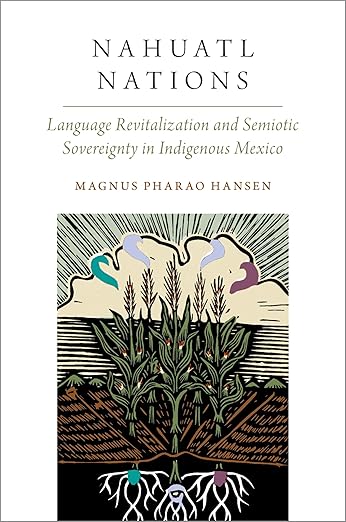
My book Nahuatl Nations: Language Revitalization and Semiotic Sovereignty in Indigenous Mexico is out with Oxford University Press, in the series Oxford Studies in the Anthropology of Language.
The book is a lin guistic ethnography of the political relations between the Indigenous communities of Mexico that speak Nahuatl and the Mexican nation that claims the language as a national symbol. Drawing on long-term fieldwork in several Nahuatl-speaking communities in central Mexico, and on ethnohistorical and sociolinguistic material, it traces how those relations have been shaped over time and how they play out today in Nahua towns, in regional educational institutions, and in the Mexican diaspora in the United States.
Its central argument turns on the concept of semiotic sovereignty: a community’s capacity to govern its own semiotic resources, its language among them. I argue that Indigenous languages remain vital for as long as they are used as languages of political community, and that they protect that community by restricting outsiders’ access to participation in it. Where the Mexican state seeks to expropriate Indigenous semiotic resources to improve its brand abroad, communities can deploy those same resources in resistance to state domination.


Leave a Reply